
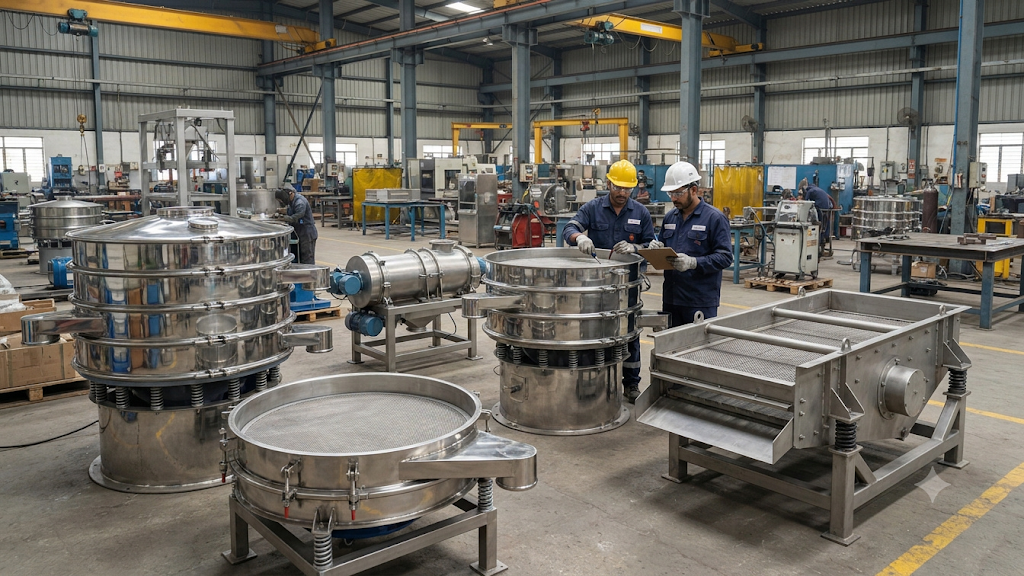
Choosing the wrong screening machine rarely fails on day one—it shows up weeks later as screen blinding, low hourly output, cross-contamination, or frequent mesh replacement. Whether you are grading pharmaceutical APIs, sifting spices, separating minerals, or dewatering slurries, matching machine geometry to your material behavior is the single biggest factor in screening efficiency.
This technical selection guide breaks down how different Sieving & Screening Machines work, when to use single vs. multi-deck configurations, and what engineering parameters to check before requesting a quotation.
1. Matching the Machine Type to Your Process Application
Not all vibratory separators move material the same way. Depending on whether your priority is fine micron grading, high-volume check-screening, or continuous bulk scalping, three primary designs cover most industrial lines:
Circular / Round Vibro Sifter (Multi-Deck Precision Grading)
Driven by a vertical vibratory motor with eccentric top and bottom weights, a Circular Vibro Sifter generates three-dimensional gyratory motion.
- Best For: Separating dry powders and granules into multiple particle size fractions (up to 4–5 decks) or solid-liquid separation.
- Common Industries: Pharmaceuticals (APIs & excipients), nutraceuticals, food powders, fine chemicals, and ceramics.
Inline Vibro Sifter (Direct Chute Integration & Check-Screening)
Unlike standard round sifters where material exits from the side, an Inline Vibro Sifter features dual side-mounted vibratory motors and a straight-through center discharge.
- Best For: High-speed safety screening (policing) right below a blender, pulverizer, or above a bagging/filling line where vertical headroom is limited.
- Key Advantage: Eliminates horizontal offset piping and prevents bottlenecking in continuous automated lines.
Rectangular Vibrating Screen (High-Capacity Bulk Scalping)
Built with a linear trough geometry, a Rectangular Vibrating Screen moves heavy bulk solids across a larger screening surface area.
- Best For: High-tonnage scalping, coarse grading, and dewatering of heavy or abrasive materials.
- Common Industries: Minerals, fertilizers, plastic granules, grains, and bulk chemical processing.
2. Quick Comparison: Which Screening Machine Fits Your Material?
| Machine Type | Ideal Applications | Deck Options | Key Operational Advantage |
|---|---|---|---|
| Circular / Round Vibro Sifter | Pharma APIs, Spices, Flour, Fine Chemicals, Slurries | 1 to 4 Decks | Multi-fraction particle grading with compact footprint & zero dead zones |
| Inline Vibro Sifter | Flour Mills, Sugar, Bulk Powders, Pre-Packaging Check | Single Deck | Direct center discharge for high-speed inline safety screening |
| Rectangular Vibrating Screen | Minerals, Plastic Pellets, Grains, Fertilizers | 1 to 3 Decks | High-tonnage throughput for coarse scalping & heavy bulk loads |
3. Five Engineering Parameters to Finalize Before Sizing a Sifter
Before finalizing a machine diameter (such as 24", 30", 36", 48", or 60") or motor rating, process engineers evaluate five material characteristics:
- Particle Size Distribution & Mesh Size (20 Mesh to 500 Mesh): Fine powders below 200 mesh require larger effective screening area and anti-blinding systems (such as silicone bouncing balls or ultrasonic de-blinding) to keep apertures open.
- Bulk Density & Moisture Content: Light, fluffy powders (like starch or herbal extracts) behave very differently from dense metallic or mineral powders. High moisture or fat content (like spices or cocoa) requires specialized mesh tensioning and de-blinding trays.
- Required Hourly Throughput (kg/hr or tons/hr): Oversizing wastes floor space and power; undersizing forces operators to overfeed the screen, reducing separation accuracy.
- Contact Material & Hygiene Grade (SS 304 vs. SS 316): Pharmaceutical, food, and dairy lines require mirror-polished SS 316 / SS 304 contact parts with FDA-compliant silicone gaskets and clamp-mounted quick-release decks for fast washdowns.
- Dust-Tight Operation: Toxic APIs or fine combustible powders require sealed top covers, flexible inlet/outlet bellows, and dust-free discharge chutes.
Get a Custom Machine Sizing & Mesh Recommendation for Your Material
Because two powders with the same mesh size can have vastly different flow rates depending on bulk density and static charge, selecting the right diameter and motor configuration requires application-specific sizing.
Explore full technical specifications, deck configurations, and machine models on our Industrial Sieving & Screening Machines page—or share your material name, bulk density, target mesh size, and required kg/hr output with our engineering team at Pan India Vibration Technic for a tailored equipment recommendation and quotation.
No comment